
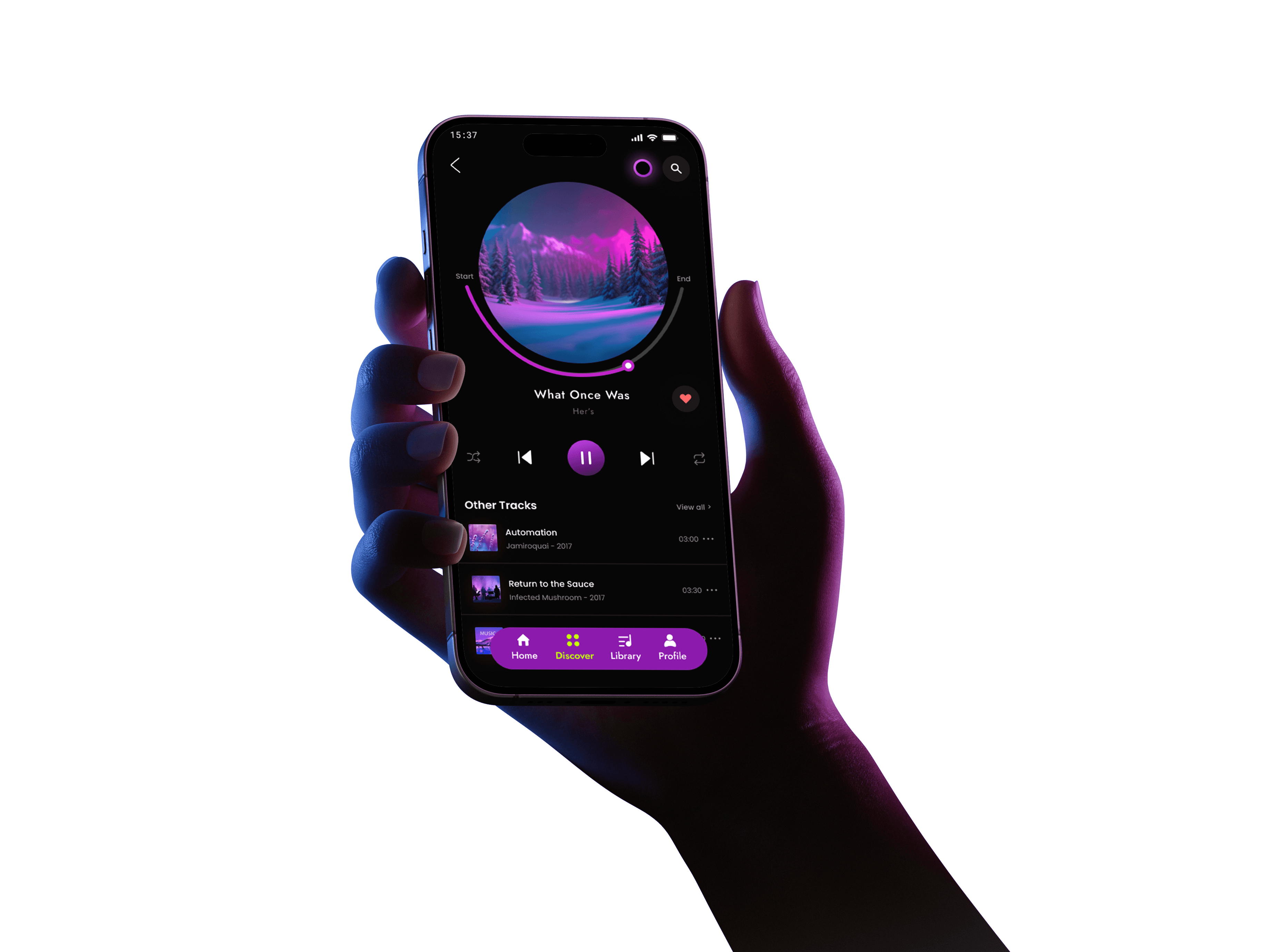
Emotion Aware Music Discovery App
SYNC
Hats worn
Product Designer
User Researcher
UI Designer
Data Visualizer
Team
Yashswee Sinha
Rujuta Sanghvi
Akhil Nalluri
Mentor
Pia Zaragoza
Timeline
Google Design Sprint
4 weeks
We spoke to users who rely on music while working, commuting, or winding down; where mood clearly shapes what they listen to. Here’s what they had to say...
“Sometimes I just want to hit play and feel understood, not scroll endlessly for the right song.”
“The right playlist can turn a good workout into a great one, but that same playlist doesn’t work when I’m trying to relax.”
“It’s wild that my phone knows where I am, but my music still feels random.”
“I wear a smartwatch that tracks my heart rate and stress, why can’t my music respond to that too?”
Overview
SYNC is a smart music discovery app that integrates with wearables to detect emotional and environmental cues like heart rate, stress levels, activity, and location and offers mood-aligned, adaptive music recommendations in real time.
What problem am I trying to solve?
Music is emotional but most apps treat it like data.
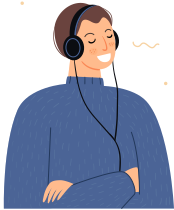
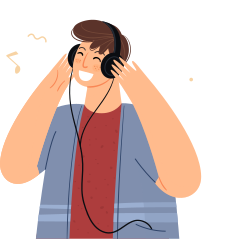
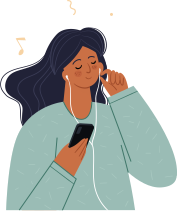
People are overwhelmed, stressed, and constantly multitasking, yet 70% skip songs that don’t “feel right.”

79% use music to match or change their mood
83% say music helps regulate their mental state
72% of Gen Z & Millennials want emotionally intelligent tech
1.1B+ wearable devices are in use globally...and growing
70% skip songs that don’t fit how they feel
64% would pay more for personalized, wellness-focused music apps
Problem Statement
How might we use real-time emotional and environmental data to create music experiences that truly resonate with how people feel in the moment?
Why it matters?
Music is emotionally driven, but existing apps treat it as a static playlist experience.
Users often skip tracks, feel unsatisfied, or spend time searching for “the right vibe.”
With the rise of wearables and biofeedback, there’s a huge opportunity to create truly adaptive and emotionally intelligent listening.
Whose problem am I solving?
Emotionally-aware individuals who want music that intuitively matches their mood, activity, and environment in real time.
Music Needs to Be Emotionally Aware
Users want music to feel them not just follow algorithms.
Context Changes Constantly
One playlist doesn’t fit every moment, users crave music that adapts to their environment and energy.
Wellness Tech Is Smart, Music Should Be Too
Users expect their music experience to evolve like their wearables: automatic, intelligent, and deeply personal.
Key insights from our 1:1 interviews
seeing how underused wearable data really is. Many participants tracked stress or heart rate daily, but none had seen that data connect to something as personal as music.
That gap felt like a huge opportunity.
A big “Aha” moment was
Another breakthrough was discovering that users weren’t asking for control, they were asking for relief. They didn’t want to curate more playlists; they wanted the music to just feel right without effort.
"Imagine walking on a rainy day. You feel the cool breeze, hear droplets tapping on your umbrella. Your music app senses the rain and switches to a calming piano melody, syncing your world to your mood.”
That’s the power of SYNC.”
The Day Music Changed
A Seamless Mood-Aware Listening Journey
Introducing
SYNC
SYNC gives users a personalized emotional brief, blending weather data, biometric signals, and tone of the day to acknowledge how they might be feeling.
It’s not just about music.
It’s about saying: “Hey, we see you. We get how you feel today.”
You open the app and instantly connect it to your wearable like a smartwatch. SYNC begins analyzing your physical and environmental state.
SYNC gives users a personalized emotional brief, blending weather data, biometric signals, and tone of the day to acknowledge how they might be feeling.
It’s not just about music.
It’s about saying: “Hey, we see you. We get how you feel today.”
After SYNC interprets your emotional and environmental state, it transitions seamlessly into a mood-aligned playlist
no searching, no scrolling. Just music that feels right.
Whether the user is feeling tired on a hot day or calm on a snowy evening, the songs are curated to support, elevate, or gently shift that mood all in real time.
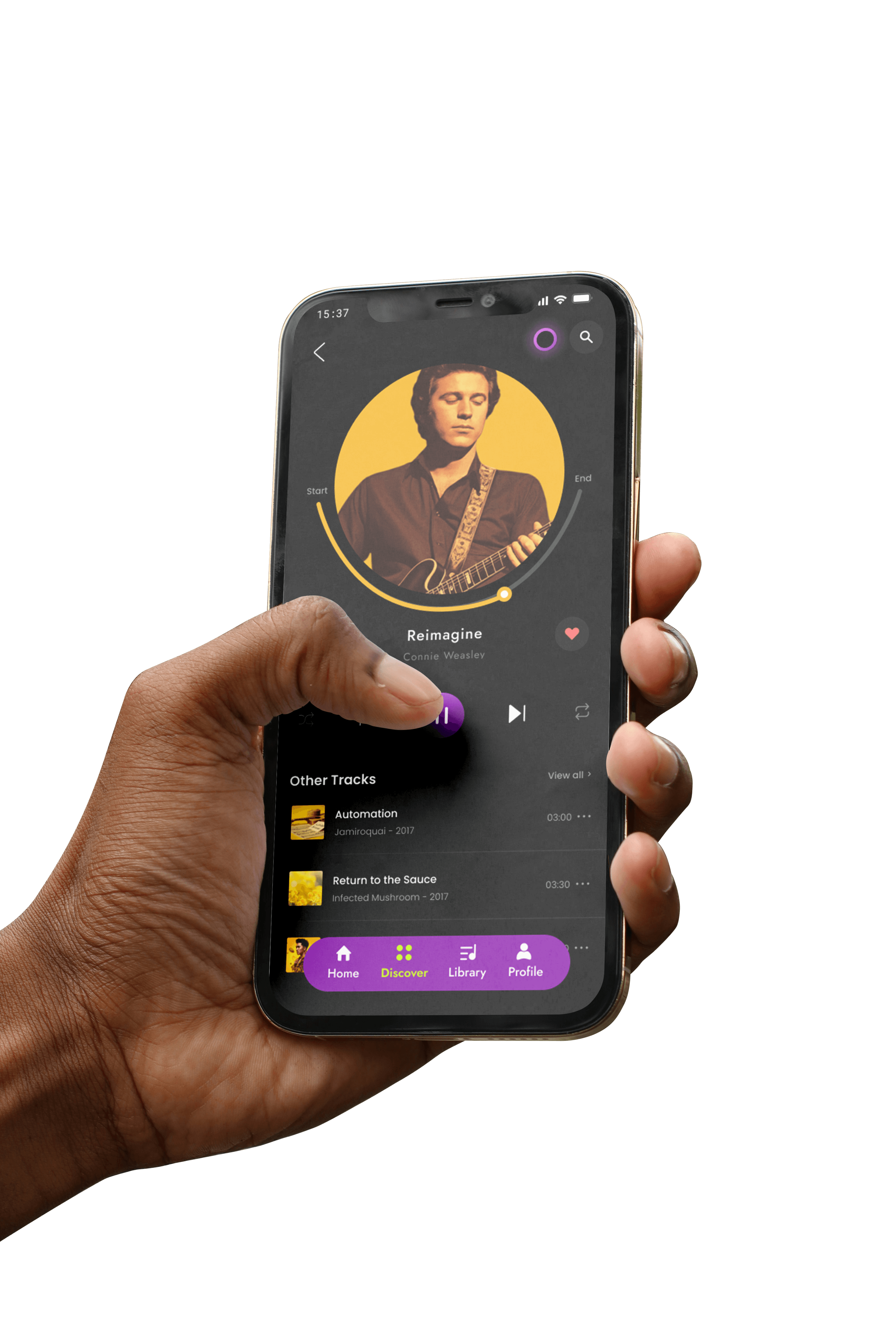
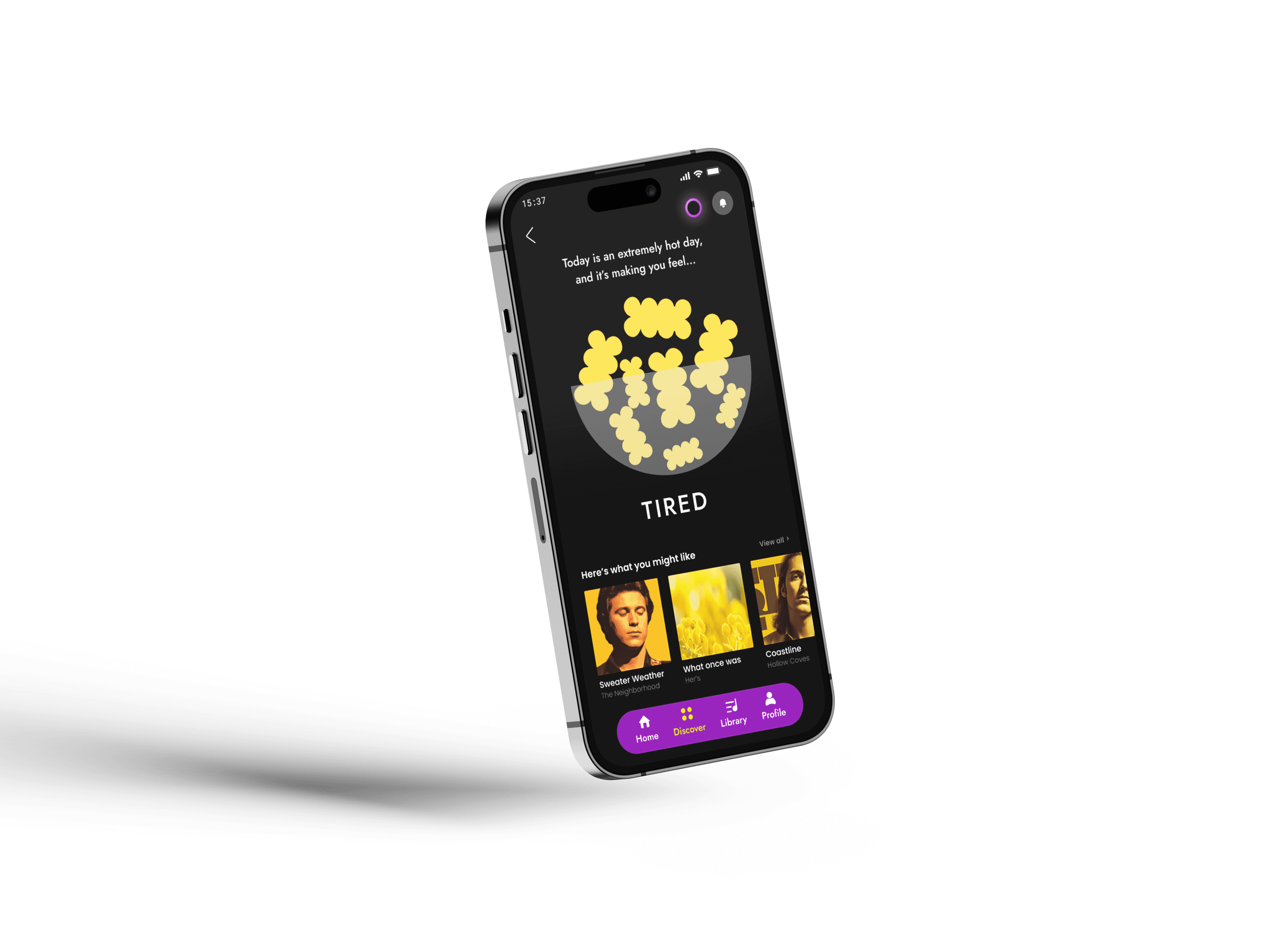
“While most music apps rely on past behavior, SYNC looks at the present moment. It adapts to your world...how you feel, what’s around you, and what you need right now.”
Testing & Validation Plan
To ensure SYNC delivers on its promise of real-time, emotionally aware music, I would take a mixed-method approach combining usability testing, contextual feedback, and data-driven insights.
Usability Testing
Goal: See if users understand and enjoy using SYNC.
To test SYNC, I would run a usability study using a high-fidelity prototype. I’d invite 10-15 users from the target audience and ask them to interact with the app in real-life situations like commuting, post-workout, or winding down.
I’d observe how easily they navigate the interface, whether they understand the mood-sync feature, and how the experience makes them feel.
Scenario Testing with Simulated Wearable Data
1
2
3
Goal: Test how well SYNC adapts to mood and environment changes.
I would run context-based testing using simulated data from wearables like increased heart rate or stress levels to mimic different emotional states.
I’d see how well the app adapts to focused, active, or relaxed moments and ask users if the music felt right for how they were feeling.
Metrics to Track Impact
Metric
Why it Matters
To measure SYNC’s impact, I’d track how often users skip songs, how long they stay engaged, whether the music matched their mood, and if they’d want to use the app again. These insights would help refine the experience and validate that SYNC creates a more meaningful, personalized way to listen to music.
Fewer skips = better mood matching
Longer listening = higher engagement
Ask: “Did this feel right for your mood?”
Would users come back and use SYNC again?
Song Skip Rate
Session Duration
Mood Match Feedback
Return Intent
I overcomplicated the first version.
In early mockups, I packed in too many features. During testing, users felt overwhelmed. I learned to simplify, prioritize one clear action, and let the emotion guide the experience not the interface.
Wearables opened a new design space I hadn’t explored.
I had never designed for biosignal data before. It was exciting and intimidating. I failed a few times trying to figure out how heart rate or stress could influence music choices, but once I simplified it into three core states—focus, active, and rest—it clicked.
Designing with emotion sounds easy...
until you try it
I initially assumed emotional states could be neatly mapped to playlists. But I quickly realized that feelings are fluid and messy. I struggled to define how "mood" should translate into music suggestions. Talking to users helped me shift from trying to predict emotion perfectly to simply supporting it intuitively.
Google Design Sprint taught me to let go of perfection
Working in a fast-paced sprint meant moving from idea to prototype in days—not weeks. It was my first time designing without overthinking. I learned to trust the process, test often, and let user feedback shape the direction instead of trying to get it “right” from the start.
What did I learn from this project?
Scrolled till here?
Don’t be a stranger. Let’s Talk.


This portfolio is a living, breathing work-in-progress just like me. Evolving as I grow through design and life :)